
Don’t Ignore Oregon IP28
It’s Just the Beginning of the Animal Extremist Agenda
Oregon’s Initiative Petition 28 (IP 28), particularly Article 2, is not just another ballot measure—it is a symptom of a calculated, long-term campaign by animal rights extremists to fundamentally reshape society. While its backers may know it faces steep odds of actually passing in its current form, the likelihood of failure is not a concern. The real objective is normalization: getting radical ideas about banning or severely restricting animal use onto the ballot, into the news cycle, and eventually into the public consciousness. This is incrementalism at its most insidious.
In political theory, the term “Overton Window” describes the range of ideas or policies that are considered acceptable or mainstream by the public at any given time. Extremist groups shift it incrementally by repeatedly pushing radical proposals until yesterday’s unthinkable idea becomes today’s ‘moderate’ compromise.”
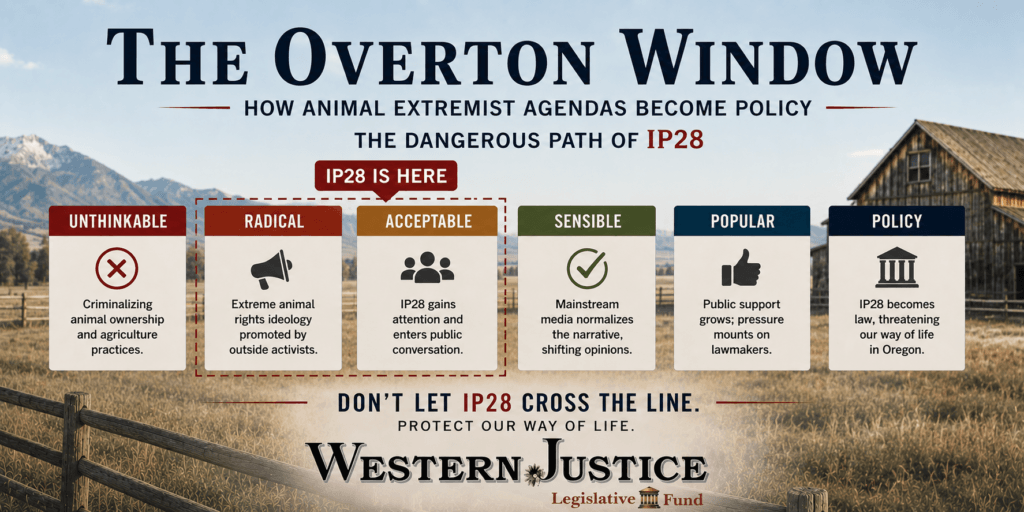
David Michelson, chief IP28 petitioner, said in social media video, “For our campaign, what a win looks like is so different than what some other campaigns would call a win because we know that this isn’t going to pass in 2026, but we still feel like we’re winning when we’re having those conversations, when we’re seeing our numbers of people involved in the campaign grow…”
This isn’t the first rodeo for the animal extremist movement. A similar push was attempted in Colorado for the 2022 ballot, called Colorado Initiative 16 (also known as the PAUSE Act — “Protect Animals from Unnecessary Suffering and Exploitation”). The Colorado Supreme Court unanimously rejected it in June 2021 (7-0 ruling). The court ruled that the measure violated the state’s single-subject requirement for ballot initiatives. This killed the effort for that cycle; any signatures collected became invalid, and proponents would have had to start over from scratch with a rewritten version.
In Oregon itself, earlier versions of IP28 failed to gather enough signatures to reach the ballot. Now it stands poised to qualify. Each attempt moves the “Overton Window” a little further, making what once seemed extreme appear merely “progressive” or “compassionate.”
Animal rights extremists have mastered the art of the long game. For decades, they have worked methodically to erode the cultural acceptance of humans’ millennia-old relationship with animals—whether for food, work, sport, or companionship. They understand that language is power. Terms like “puppy mill,” “slaughter pipeline,” “backyard breeder,” and “welfare ranchers” did not emerge organically into everyday conversation. They were deliberately injected into the public lexicon by well-funded extremist groups to frame standard animal and land stewardship practices as villainous.
Bit by bit, as these loaded phrases become standard, public perception shifts. What begins as emotional rhetoric about “cruelty” evolves into policy that restricts breeding, ownership, agriculture, and recreation. Today it’s stricter regulations on horse breeders or ranchers. Tomorrow it’s broader bans. The strategy is death by a thousand cuts to our rights and traditions.
Make no mistake about the end goal. This movement does not seek better welfare standards or responsible stewardship—it seeks the complete elimination of animal use by humans in any form. The quotes from leading figures in the movement reveal the chilling truth:
“We have no ethical obligation to preserve the different breeds of livestock produced through selective breeding … One generation and out. We have no problems with the extinction of domestic animals. They are creations of human selective breeding.”
— Wayne Pacelle, former president of the Humane Society of the United States (HSUS)
And from Patrick Battuello of Horse Racing Wrongs:
“…then, sterilize to extinction—a planet devoid of Thoroughbreds, Quarter Horses, Standardbreds and everything in between…”
While these may seem like fringe voices, they represent the ideological core driving much of the activism behind measures like Oregon IP 28. Domestic animals—carefully bred and partnered with humans for thousands of years—would be deliberately driven to extinction under this worldview. Horses, cattle, dogs, and other species that have co-evolved with humanity would simply cease to exist as we know them. This is not compassion; it is anti-humanist cultural, biological, and evolutionary erasure.
Compounding the threat is the influx of foreign funds and foreign actors bankrolling these campaigns. Millions flow in from overseas donors and organizations with no stake in American rural life, agriculture, or Western traditions. Their goal is to impose an urban-centric, ideological vision on working landscapes they neither understand nor respect.
Ranchers, horse breeders, farmers, hunters, competitors, and everyday pet owners are on the front lines of this struggle. The extremists’ incremental approach—normalizing ballot measures, shifting language, and reframing responsible animal use as exploitation—threatens not just livelihoods but an entire society built on mutual benefit between humans and animals.
Oregonians (and Americans everywhere) must recognize IP 28 and similar efforts for what they are: stepping stones toward a radical future where humans are separated from animals entirely. The danger lies not in any single ballot measure, but in the sustained, well-funded campaign behind them. Awareness is the first defense. Rejecting normalization is essential. Fighting back is vital. Our relationship with animals—rooted in respect, responsibility, and thousands of years of shared history—deserves to be defended, not dismantled.
The long game is underway. The question is whether we will wake up in time to counter it.
Your support is crucial to help us fight IP28 and the agenda behind it. Join Western Justice today. www.westernjustice.info/memberships
Read more about Oregon IP28 HERE.
Western Justice Legislative Fund Email Address: [email protected]
Western Justice Legislative Fund is a Non-Profit, 501(c)(4) Organization
Internal Revenue Code: EIN # 85-1738984 Registered in Wyoming.
Mailing address ~ P.O. Box 454 Hermiston, OR 97838
Disclaimer: Contributions to WJLF are not deductible as charitable contributions for federal income tax purposes. They may be deductible as trade or business expenses if ordinary and necessary in the conduct of the taxpayer’s business. Please consult with your tax adviser.

News from the horse industry. Sharing today’s information as it happens. The Colorado Horse Source is not responsible for the content of 3rd party submissions.