
Every horse owner knows the feeling. You finally get a warm stretch of weather, the horses are shedding out, pasture season is starting to look good… and suddenly the bugs arrive in full force.
Flies, mosquitoes, gnats, and biting midges can make horses absolutely miserable this time of year. And honestly, some summers it feels like you spend more time fighting insects than actually enjoying the season.
The good news is there are a lot of simple, natural management changes that can make a noticeable difference around a horse property.
Biting Insects Can Lead to Serious Health Problems in Horses and Humans
Ahh, summer… the long days, the sun and warmth. The season is wonderful in so many ways, except when it comes to those annoying bugs. Flies, gnats, and mosquitoes can make our horses’ lives miserable (ours too), and can lead to serious health problems. So, what can we do? Here are 10 tips to help create less buggy horse properties:
1. Pick up and compost manure regularly. Horses produce 50 pounds of manure per horse per day—the prime habitat for several types of filth flies. Removing manure daily from stalls, paddocks, arenas, and high traffic areas will help eliminate fly habitat.
Composting manure generates heat which destroys fly habitat and breaks down manure so plants can utilize it. Compost is a free, easy, and very valuable soil amendment that locks in soil moisture, stimulates biological activity in soil, adds nutrients, suppresses plant disease, and helps grow healthier plants—and pastures! Applying compost to pastures will help hold in soil moisture and get your pastures through the droughty times.
For manure in pastures, harrow (or drag) them regularly to break up manure piles. Harrowing spreads manure so plants can use nutrients and organic materials. Spreading also dries out manure, making it a less attractive habitat for flies.
2. Manage mud. Mud is an insect’s happy place. Install rain gutters and roof runoff systems on all barns, sheds, and outbuildings and divert the clean rainwater away from high traffic areas. This substantially reduces the amount of mud created in your confinement and high traffic areas. It also reduces the amount of nutrients and sediments (from mud and manure) which gets washed into the surface waters.
You can also reduce mud and erosion by using footing materials such as finely crushed gravel (sized 5/8 inch or less) or coarse sand in confinement and high traffic areas. Three to six inches of material will help build up the area, keeping horses up out of the dirt and allowing rainwater to drain through.
Avoid creating mud in pastures (insect habitat) by grazing horses on higher, drier pastures at the beginning of the summer. Save the lower, wet pastures (which harbor mosquitoes, deer flies, horse flies, and biting midges) until later in the summer when those areas dry out.
3. Clean feed tubs and water buckets regularly. Dirty feed tubs are an attractant to flies which are looking for any kind of goo to feed on. Regular cleaning reduces the fly attracting material along with disease-causing bacteria.
Stagnant water (water that has not been moving or added to for 5 to 7 days), can become a breeding site for mosquitoes. Dump, scrub, and refill stock tanks every week to prevent and reduce mosquito habitat.
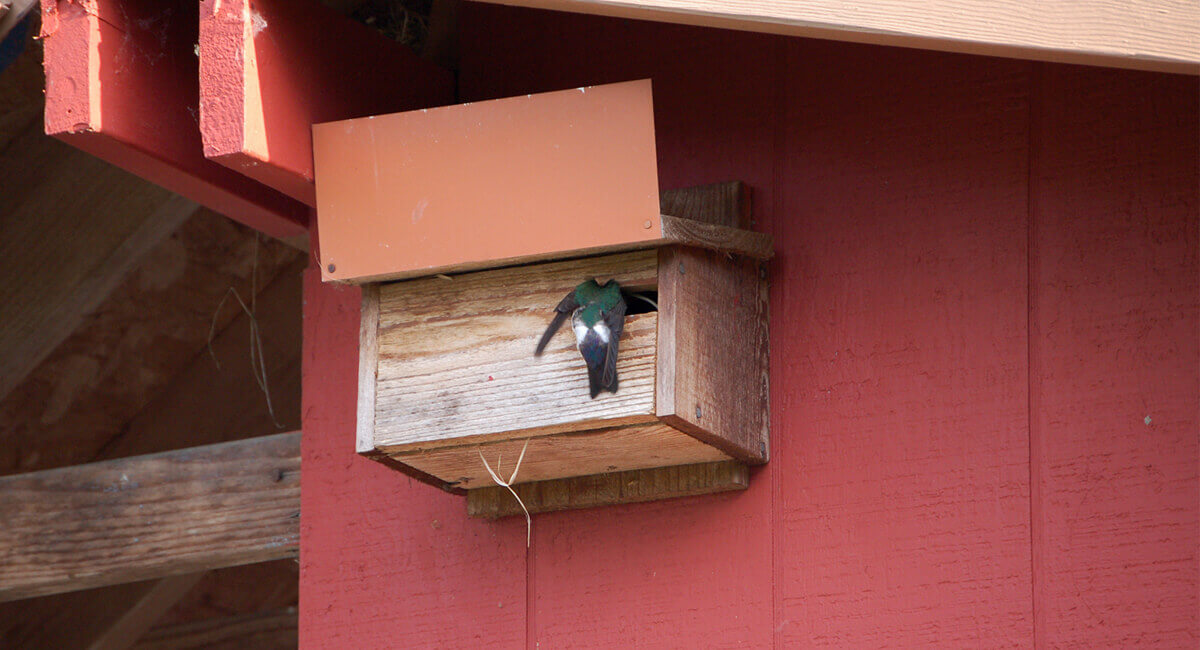
4. Build nest boxes for insect-eating birds. Encouraging swallows, bluebirds, and Purple Martins to move into your yard and barn area is an excellent method for reducing flying insect populations. Members of the swallow family can be a tremendous asset to a horse facility as they dive and dart through the neighborhood collecting bugs. One adult barn swallow will consume several thousand insects per day, a number comparable with a bug zapper but much safer than using insecticides.
Nesting can be encouraged by hanging nest boxes specific to the type of bird in your area. Swallows, such as Violet Greens, will utilize nesting material such as hair shed from horses or dogs.
5. Bat boxes for nocturnal insects. Bats play an important part in every healthy environment by eating the nocturnal flying insects that plague our horses and us, such as mosquitoes. Bats are reported to eat up to 600 mosquitoes an hour, more than 5,000 a night.
Encourage a bat family to move to your property by hanging a bat box built specifically for the types of bats common in your region.
6. Fly parasitoids. One example of a beneficial insect horse owners can put to work is the fly parasite, a gnat-sized, nocturnal wasp which lays its eggs in the developing pupae of flies thereby reducing the fly population. They do not harm humans or animals in any way and are rarely even noticed since they are tiny and active only at night.
Commercially raised fly parasites can be purchased from several sources; do an internet search with the words “fly parasite” to locate sources. To be most effective as a fly control method, fly parasites should be released early in the fly season and every four weeks thereafter.
7. Non-chemical fly traps and tapes. Several types of simple non-toxic insect traps can be extremely useful for reducing the flying insect population. The cheapest and easiest are sticky traps; flying insects happen across them and get stuck. Fly paper or sticky tape can be attached above doorways or from barn ceilings. Old-fashioned sticky strips, the coiled kind, are probably the cheapest and easiest to utilize. Try hanging many, like 10 or more, from your barn ceiling. Once full of dead flies, remove the tape and hang fresh ones. Choose locations carefully to avoid contact with human hair or swishing horse tails.
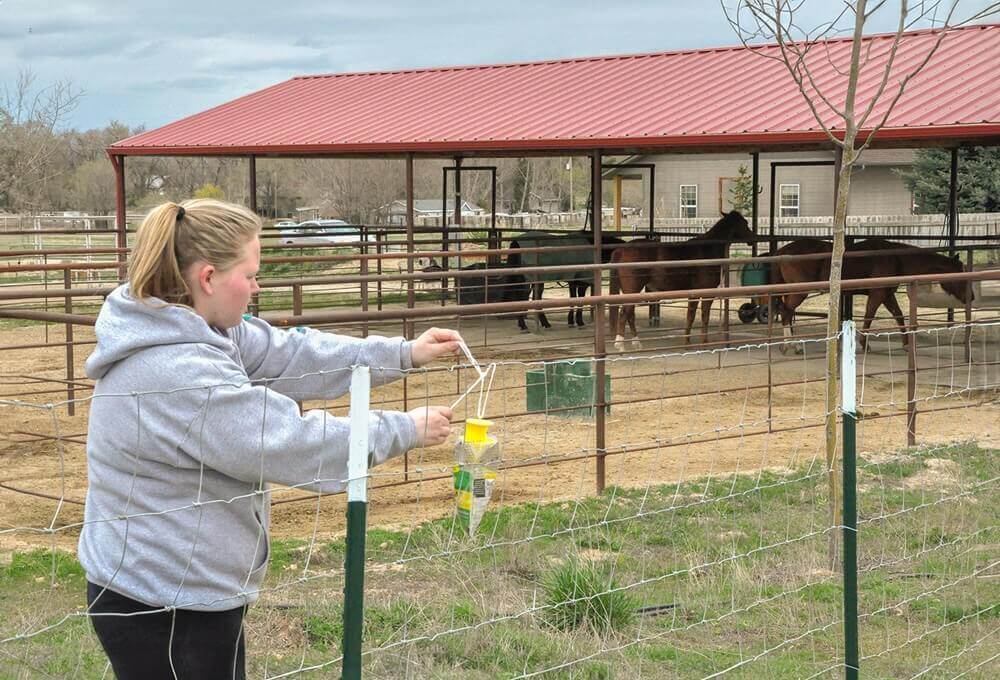
Several brands of pesticide-free bags are on the market. A stinky attractant is used in these that activates when dissolved in water. Lured by the scent (and perhaps the color), flies enter the trap through the yellow cap top and drown in the water. Bags come ready to hang and use and are easy to dispose of when full by tossing into the trash. There are also reusable varieties.
Place the attractant bags on the perimeter of your property to lure flies away from high traffic areas. The downside to these traps is they are smelly; another good reason to locate them away from barn areas.
8. Fly masks, fly sheets, and fly boots. Protective coverings act as a mechanical barrier between horse and fly, and also act as a sunscreen for horses sensitive to sunburn. Some masks protect just the eyes while others also protect ears and muzzle. You can protect the rest of your horse’s body with fly sheets (cool, open-weave, lightweight mesh blankets), and fly boots which help protect legs from biting flies.
9. Shady stalls or run-in sheds. Some insects such as face flies, biting midges, and deer or horse flies do not like to enter darkened barns or stables. Provide your horse with a shelter or put them inside a barn before and during dusk (when these insects are most active) to help horses escape heavy attacks of these creatures.
10. Fans. Biting midges and mosquitoes tend to be poor flyers, so good ventilation or a fan placed safely outside a stall can create enough air movement to help individual horses particularly tormented by bugs.
For assistance with determining the insect-eating birds specific to your part of the country and their nest box needs, consult your local Audubon Society, birding organization, extension office, wild bird store, or the library. For help with mud, manure, or pasture management, contact your local conservation district.
For more information on each of these topics visit the Horses for Clean Water website www.horsesforcleanwater.com.