
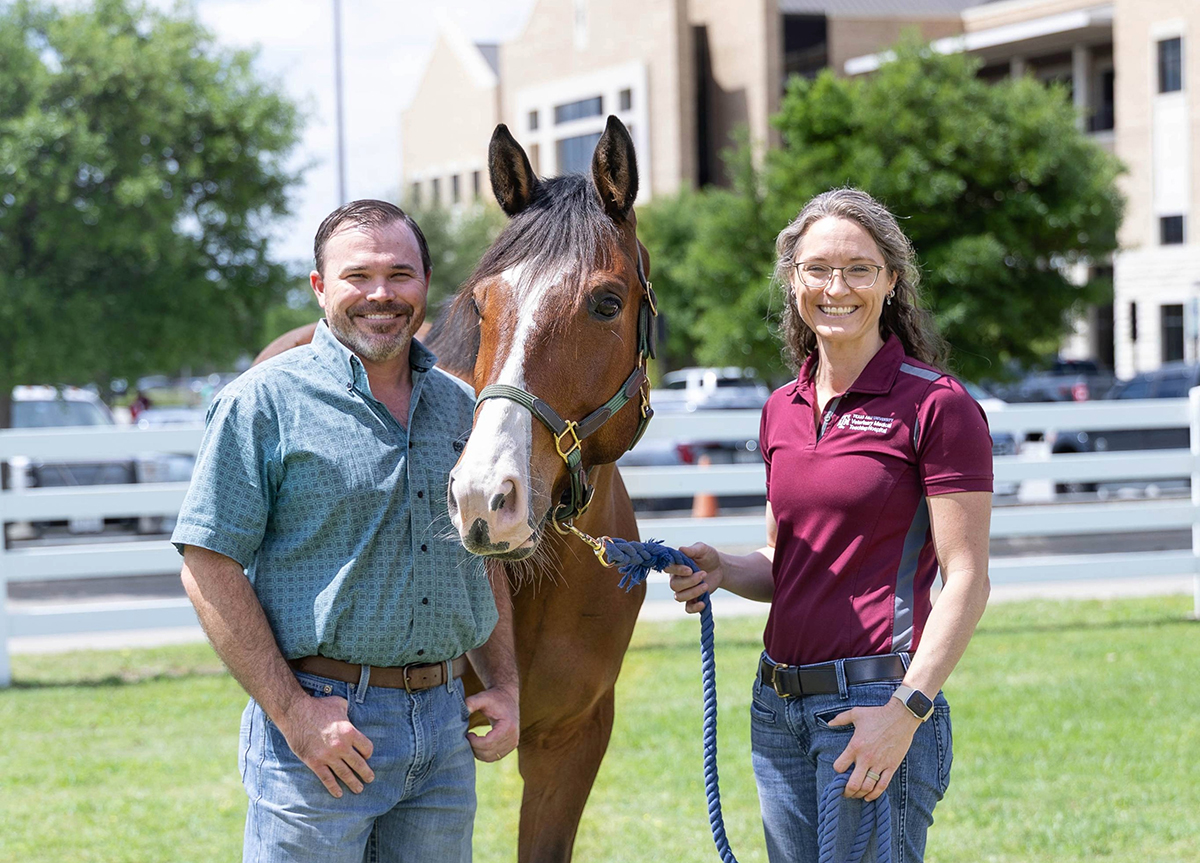
After years of unexplained performance struggles, Captain was diagnosed with cervical spinal cord compression and treated with a new equine-specific stabilization implant at the Texas A&M Large Animal Teaching Hospital. Read online
BRYAN-COLLEGE STATION, Oct. 2, 2026 — At first, nothing about Captain seemed unusual. In fact, when Katie Bartschi purchased the 4-year-old from Canada after unexpectedly losing her previous horse, she was drawn to the bloodlines and calm demeanor that would make Captain a good fit to be trained as a jumper.
Instead, Bartschi found herself surprised that the young horse was taking longer than expected to develop, finding even basic progression under saddle to be difficult. Even on the hard days, he tried to do what was being asked of him, but he moved with tension through his neck and back, often bracing instead of moving freely, and while the behavior was subtle, Bartschi knew something was not right.
“Walking and trotting developed slowly, but the canter never fully came together,” she said. “Captain was never dangerous or unwilling; in fact, his willingness was what made the situation so difficult to understand.
“It didn’t feel like he was saying, ‘I don’t want to,’” Bartschi said. “It felt like he was saying, ‘I can’t.’”
A struggle beyond training
As Captain struggled, Bartschi never gave up on him. A mother of three young children, she approached training with patience and caution, building a program centered on groundwork and routine care.
“We just kept trying to make him as comfortable as possible,” Bartschi said. “We wanted to give him every chance to figure it out.”
Over the years, Bartschi and Captain’s trainer, Devereaux Branham, devoted significant time and effort to understanding Captain’s challenges, adjusting his program, and searching for answers as his progress remained inconsistent.
In late 2025, the pattern shifted. Captain started tossing his head in a way that felt different from the training issues they had worked through before.
After two visits with a local clinic, Bartschi decided to take Captain to the Texas A&M Large Animal Teaching Hospital, where a team led by Dr. Kati Glass and Dr. Weston Warnock began a more extensive diagnostic workup.
“It was challenging to pinpoint exactly what the main problem was initially,” said Glass, a clinical associate professor of equine orthopedic surgery and equine sports medicine and imaging. “He was having some lameness problems, he wasn’t quite himself, and he wasn’t performing to the level they expected. Ultimately, it became clear that neurologic dysfunction and pain was contributing.”
Bringing the problem into focus
To further investigate the source of these issues, a CT myelogram, an imaging procedure used to evaluate the spinal cord and surrounding structures, was performed. It revealed a disc protrusion between the C6 and C7 vertebrae in Captain’s neck that had resulted in spinal cord and spinal nerve root compression.
“For a long time, intervertebral disc disease was thought to not happen in horses,” said Warnock, also a clinical associate professor of equine orthopedic surgery and equine sports medicine and imaging. “What looks like a forelimb lameness issue, in some cases, can actually be due to cervical pain or spinal nerve pain, as was the case with Captain.”
With a diagnosis confirmed, the conversation shifted to treatment options.
In Captain’s case, that meant cervical stabilization surgery using a new implant system developed by French veterinarian Dr. Fabrice Rossignol specifically for horses.
“It is the first big innovation in cervical spine surgery in a long time,” Glass said. “This implant system was designed specifically for equine cervical fusions using the latest cervical surgical technology. We were really excited about the opportunity to use this new implant for Captain’s surgery, which would allow us to stabilize the affected vertebrae, allowing the compression and instability in Captain’s neck to resolve.”
Recovery and rehabilitation
An important part of the recovery process is rehabilitation, especially for neurologic recovery, which depends on repetition and controlled movement to help restore communication between the spinal cord and the rest of the body, according to Glass.
“We’re actually recovering Captain’s neurologic system, and that takes a lot of practice,” she said.
Captain’s rehabilitation program includes controlled exercises and structured movements designed to gradually rebuild strength, balance, and coordination.
While the veterinary team remains optimistic about Captain’s recovery, even in the early stages, Bartschi has started to notice a change in him.
“He is very calm and a different horse already,” she said.
“These cases take time for spinal cord and nerve recovery,” Warnock said. “But the early signs of improvement are incredibly encouraging.”
Raising the standard of care through collaboration
For the veterinary team, Captain’s case represents more than a single surgery — it also reflects years of collaboration and a growing understanding of spinal diseases in horses.
“This collaboration is critical,” Glass said. “We are constantly reflecting on what we are doing and how it can be done better. We don’t want to be complacent; we are always working to improve our current options and toward new interventions so that we can help more horses with more problems.”
Beyond that, Warnock believes this case represents the future of equine surgery, particularly for spinal procedures.
“I think in five years we will probably have the conversation about what we didn’t know today and how much we continue to learn,” he said. “Spinal surgery in horses is rapidly evolving, with new diagnostic and therapeutic options being developed constantly.”
As such, Captain’s case also represents more than one horse’s recovery.
“This is part of a larger shift in how we understand performance issues in horses,” Glass said. “It is expanding what we think is possible in terms of diagnosis and treatment.”
For Bartschi, however, the meaning of Captain’s recovery is personal. After years of trying to understand what Captain was struggling to communicate, she finally has an answer.
More importantly, she now has the opportunity to give him what she wanted for him all along — the chance to move comfortably, confidently, and painlessly.
As Captain continues his rehabilitation, Bartschi and Branham are beginning to see a calmer, more peaceful horse emerge. After years of searching for answers, they are finally able to focus not on what was holding Captain back but on what may now be possible for his future.
By Haley Roedder, Texas A&M University College of Veterinary Medicine and Biomedical Sciences

News from the horse industry. Sharing today’s information as it happens. The Colorado Horse Source is not responsible for the content of 3rd party submissions.