
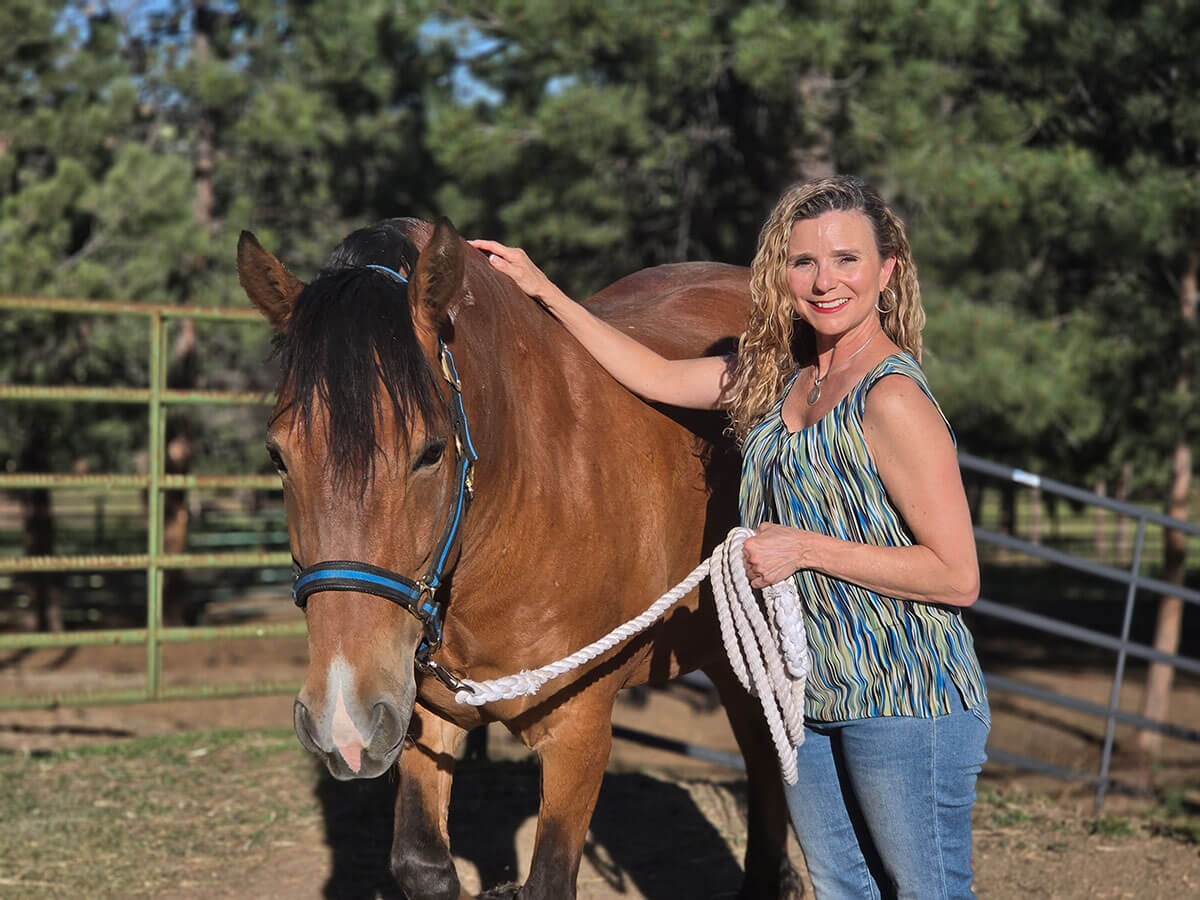
Veterinarian Dr. Jena Questen Shares How Positive Reinforcement Changed Her Approach to Horses—and Her Life
When most horse owners think about training, they think about methods passed down through generations—lessons learned from parents, trainers, mentors, and friends.
For veterinarian Dr. Jena Questen, founder of ResqRanch, a life-changing accident led her to question everything she thought she knew about horse training and behavior.
That journey ultimately led her to become one of the strongest advocates for positive reinforcement training in the horse world today.
A Life-Changing Accident
Questen always knew she wanted to work with horses. She earned a degree in Horse Racing Management, worked with racehorses in Dubai, attended veterinary school, and eventually built her own equine veterinary practice. Along the way, she was rescuing horses and teaching local horse owners and children whenever she could.
Then, in 2003, everything changed.
After purchasing a horse at auction, Questen suffered a devastating accident when the horse threw her, breaking her leg and nearly costing her the limb.
“I still have problems with that leg to this day,” she said.
Unable to work and confined to a wheelchair during her recovery, she unexpectedly discovered something that would alter the course of her career—a dolphin training manual.
The book, Animal Training: Successful Animal Management Through Positive Reinforcement, introduced her to an entirely different way of thinking about animal behavior.
“It was literally a life changer for me,” Questen said. “This book was full of information I had never heard of before.”
What surprised her most was that despite years of horse ownership, veterinary training, clinics, books, and seminars, she had never been exposed to much of the science behind animal behavior that dolphin trainers, zoo professionals, and marine mammal specialists had been using for decades.
“You can’t put a halter and lead rope on a dolphin,” Questen explained. “So how do you get them to do all the amazing things they do? Through positive reinforcement.”
More Than Treats
One of the biggest misconceptions about positive reinforcement is that it simply means handing out treats.
According to Questen, that’s not the case.
“When it’s properly executed, it’s none of those things,” she said. “It’s actually faster, safer, and leads to the most rewarding bond that you could ever have with your horse.”
At the heart of her approach is the concept of consent.
“We’re having a conversation with them every ten seconds,” she explained. “Do you consent? Is this okay? Is this okay? If it’s not, then we stop and take a deep breath.”
Instead of forcing a horse through a situation, Questen encourages owners to ask why the horse is hesitant and what they might be missing.
She believes that approach not only creates safer horses but also safer riders.
The Horse That Taught Dr. Q to Listen
One of the most powerful stories Questen shared involved a Mustang she trained for the Meeker Mustang Makeover.
The competition required trainers to prepare previously unhandled Mustangs to complete a long list of tasks within just 60 days.
The horse needed to learn to pick up his feet, load into a trailer, tolerate baths, and perform numerous other skills on a strict deadline.
As a single mother, veterinarian, and business owner, Questen found herself balancing positive reinforcement principles against the realities of limited time.
“I knew the only way I was going to get this done was to use my more traditional methods,” she admitted.
The horse performed exceptionally well and became one of her most trusted partners. He attended expos, participated in demonstrations, and seemed reliable in nearly every situation.
Then came a lesson she would never forget.
One hot day, the flies were terrible. The horse was irritated, cranky, and pinning his ears while she saddled him.
“I just didn’t pay attention to any of it,” she said. “I thought, ‘Oh, he’ll be fine.'”
After mounting, her daughter unexpectedly came up behind them on another horse. The Mustang bolted—something he had never done before.
Questen was thrown, suffering a broken arm and serious concussion.
Looking back, she doesn’t blame the horse.
Instead, she sees it as a lesson in communication.
“He was hot, he was irritated, the flies were bad, I didn’t address any of that,” she reflected.
The horse had been communicating long before she ever got on.
The pinned ears.
The irritation.
The discomfort.
She simply wasn’t listening.
That experience led her to develop what she now calls her “7-Step Pre-Flight Checklist”—a system designed to help owners evaluate a horse’s physical and emotional state before riding.
“Are they hot? Are they tired? Are they sore? Are they bothered by flies? Do you have to ride them right now?” she asks.
For Questen, the lesson was profound.
“The horse was giving me signals the whole time,” she said. “I just didn’t acknowledge them.”
A Practical Example
Questen shared a simple example involving a horse with a hoof abscess.
The horse needed to stand with his foot in a soaking bucket but repeatedly pulled it out.
Rather than forcing the issue, she paused and looked for another solution.
She introduced an icicle from the freezer.
The horse was intrigued by the cold treat on a hot day and happily focused on enjoying it while keeping his foot in the bucket long enough to complete the treatment.
For Questen, the lesson wasn’t about bribery.
It was about creating an environment where the horse could succeed.
“Bribery is getting the reward before the behavior,” she explained. “A paycheck is something we all work for. Positive reinforcement is a paycheck.”
Preparing Horses for Real Life
As a veterinarian, Questen believes positive reinforcement should extend beyond riding and training.
Horse owners should also prepare horses for veterinary exams, injections, farrier visits, trailer loading, and emergency situations.
Part of her groundwork program includes practicing with syringes, handling exercises, hoof care, and other routine procedures before they become necessary.
Living in Colorado, she is especially passionate about wildfire preparedness.
“Every horse owner should do a fire drill every spring,” she said.
That means knowing where halters are located, ensuring horses can be loaded quickly, having identification plans in place, and preparing evacuation strategies before an emergency occurs.
Making Education Accessible
Today, Questen shares her knowledge through clinics, volunteer programs, online education, and veterinary work.
She recently made her foundational positive reinforcement course available free of charge through the ResqRanch website.
The course condenses years of study and behavioral science into a format designed specifically for horse owners.
“My goal is to get this to as many people as possible,” she said.
She also offers volunteer opportunities, hands-on clinics, and scholarship assistance for individuals who may need financial help accessing advanced training programs.
Final Thoughts
When asked what she would like horse owners to remember most, her answer was simple:
“Give it a try. What do you have to lose?”
For Dr. Jena Questen, positive reinforcement is about more than training horses.
It’s about creating safer partnerships, building trust, preventing injuries, and learning to listen when horses are trying to tell us something.
Watch the Full Interview
Learn More About Dr. Jena Questen
Website: ResqRanch.org
YouTube Channel: @The1DrQ
Email: [email protected]
Free Positive Reinforcement Course: Available through the free community portal at ResqRanch.org
Volunteer Opportunities, Clinics & Scholarships: Visit the website for current opportunities and upcoming events.
Interested in sharing your business or equine story? Ask about our Legacy Spotlight and Business Spotlight programs. Contact [email protected]

Owner / Publisher | Canfield Certified Trainer
Karen Pickering is a lifelong horsewoman and the founder of The Northwest Horse Source, which began in 1995 as a small equine newsletter and grew into a respected industry publication. With more than 30 years of experience serving the horse community, Karen now focuses on helping equine businesses and organizations build visibility, credibility, and lasting relationships through online marketing, digital promotion, and educational platforms.
As a Canfield Certified Trainer, she blends proven success principles with real-world industry experience, supporting both businesses and individuals navigating change in today’s digital landscape. Karen remains deeply connected to the horse industry and is passionate about serving the community she has helped build for over three decades.
Today, Karen remains involved with every aspect of Horse Source and treasures the community of thousands who share a common passion.